Why San Antonio water is so hard, and what it does to a home
San Antonio's water comes mostly from groundwater that flows through limestone, and the limestone is the whole story. As the water moves through the Edwards and Trinity aquifers it picks up calcium and magnesium, the minerals that make water hard, and the Edwards Aquifer alone supplies about half of the city's tap water. What that means at the kitchen sink is water that measures 15 to 20 grains per gallon, well into the very hard range, with slightly different numbers depending on which blend of wells serves a neighborhood.
Hard water is not a health problem, but it is a wear-and-tear problem. The minerals dry onto every surface they touch, build up inside pipes and appliances, and force soap to work against the water to make lather. In Hill Country communities like Bulverde, Spring Branch, and Canyon Lake, where many homes are on private wells, the same hardness shows up alongside iron, which stains faucets and laundry and needs its own plan.
- White, chalky film on faucets, showerheads, and glass shower doors that comes back within a week of cleaning
- Spots and film on glasses and dishes straight out of the dishwasher, plus soap that will not lather no matter how much you use
- Stiff-feeling laundry, dull-looking clothes, and a washing machine that collects mineral film over time
- A water heater that fills with sediment and works harder every year, the single biggest cost of hard water in most San Antonio homes
- Dry, tight-feeling skin and hair after showers, and smaller things like coffee with a mineral aftertaste
How a water softener actually fixes hard water
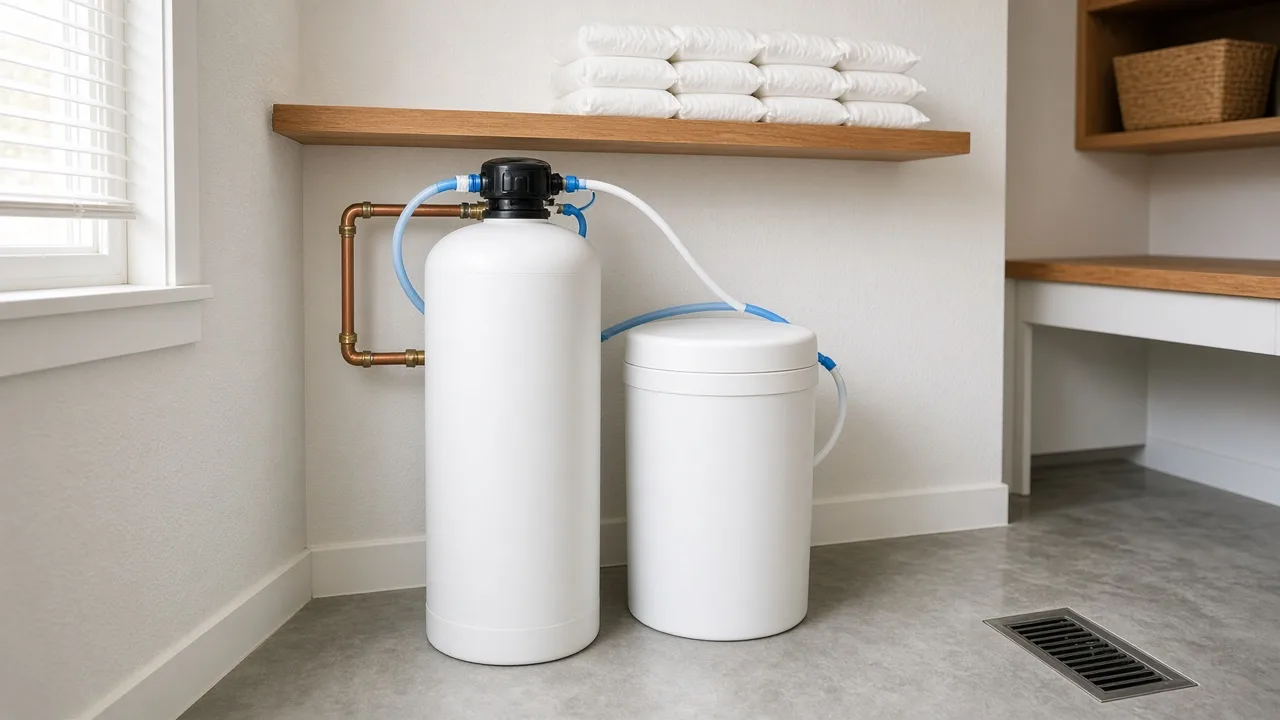
A whole-house water softener works by ion exchange, and the idea is simpler than the hardware sounds. The mineral tank is packed with resin beads that carry sodium; as hard water flows through, the beads trade that sodium for the calcium and magnesium in the water, and the soft water continues on to the rest of the house. Every few days the system runs a regeneration cycle: salt from the brine tank is pulled across the resin to wash the collected hardness down the drain and charge the beads for the next round.
- The mineral tank holds the resin beads that do the work; the brine tank beside it holds the salt and water that recharge them
- A softener installs where the main water line enters the home, so every faucet, water heater, shower, and appliance gets soft water
- Softer water means less scale in the water heater, cleaner faucets and glass, dishes that rinse clear, and soap that lathers
- A sediment pre-filter or a dedicated iron filter matters most on Hill Country wells, where iron is the usual companion to hardness
- Bypass valves and programmable control heads turn most modern units into simple, low-attention appliances
Water softener installation in San Antonio: what the job includes
A good water softener installation starts before any pipe is cut. The first step is measuring your actual hardness at the tap, usually with a test strip or a simple lab test, because that number, plus the number of people in the house, sizes the unit in grains and sets the regeneration schedule. An honest handyman quotes the right size for your home instead of the biggest unit on the truck.
The install itself is a plumbing job at the point where the main line enters the house, most often the garage, a utility closet, or an outdoor pad near the meter. The unit gets a bypass valve so it can be taken offline for service, a clean drain connection, and a dedicated electrical outlet for the control head. In San Antonio and Bexar County, tapping into the main line follows local plumbing regulations, and some Hill Country properties with private wells split the job with a licensed plumber; Ask for Chris tells you plainly when that applies before any work starts.
- A hardness test at the tap gives the grains per gallon number that sizes the unit, and household size confirms the regeneration schedule
- Placement goes where the main line enters the home, usually the garage or a utility space, with the bypass valve and drain routed cleanly
- Newer digital control heads are programmed with your hardness number and regeneration timing as part of the install, not left for you to figure out
- If water pressure is on the low side, or the home sits on a private well, flow and pressure are checked first because a softener needs flow to backwash
- The job ends with a walkthrough: where the salt goes, what each setting means, and what to check every month
Water softener maintenance in San Antonio: salt, resin, and iron
A water softener is one of the lowest-maintenance systems in a home, but low maintenance is not no maintenance. The monthly routine is mostly the salt level, and the yearly routine is a clean brine tank. Skipping both is how a San Antonio home ends up with a unit humming away that quietly stopped softening weeks ago.
- Check the salt level about once a month and keep the brine tank roughly half to two-thirds full, breaking up any hard crust or salt bridge that forms across the top
- Use the salt form your unit calls for, pellet or block, and keep the brine tank clean: sediment, rust, and debris can clog the valve
- A softener in an unheated garage is freeze material the same as pipes: before the first hard freeze, drain it or keep it in a warm space
- Iron is the Hill Country maintenance story: on wells around Spring Branch and Canyon Lake, iron can coat the resin and quietly cut its capacity until a filter or a resin cleaning brings it back
- Most modern control heads display an error or service code when the valve or motor needs attention, and catching it early beats a puddle and a softener that stopped working days ago
Water softener questions San Antonio homeowners ask
- Is a water softener worth it in San Antonio?
- For most San Antonio homes, yes, and the water heater is the biggest reason. The sediment hard water drops into a tank is what costs the most over time, shortening the heater's life and raising its energy use, and a softener removes that mineral load at the source. Homes that already receive soft water, or that mainly want better-tasting drinking water rather than less scale, have different and cheaper options, and an honest handyman says so instead of selling a system you do not need.
- Will soft water make my water taste salty?
- In normal operation, no. The ion exchange adds a small amount of sodium, typically well under what most people can taste, and softened water tastes much like the original water minus the minerals. Households on a strict low-sodium diet can use potassium chloride instead of salt in the brine tank, or keep a small reverse osmosis tap for drinking and cooking water.
- Can I have a water softener on a private well in the Hill Country?
- Yes, and plenty of homes in Bulverde, Spring Branch, and Canyon Lake run them. Well water usually needs a pre-filter or an iron filter before the softener, because iron and sediment foul the resin and wear the system out quickly, and water pressure and flow have to be sufficient for the unit's backwash cycle. It is the same install with a little more planning, and it is a conversation worth having at the estimate.
- How do I know if my water is actually hard?
- The classic signs are easy to spot: soap that will not lather, white film on faucets and showerheads, spots on dishes, and stiff laundry. The sure way is a hardness test strip at the kitchen tap, which is inexpensive and gives a grains per gallon number in about a minute. Ask for Chris brings one to the estimate, so you get a number instead of a guess before deciding anything.
- Should I get a reverse osmosis system instead of a softener?
- They do different jobs. Reverse osmosis treats the water at one tap, usually the kitchen sink, and it is excellent for drinking and cooking water, but it does nothing for scale in the water heater, showers, or appliances. Most homes that want the full effect run both: a whole-house softener for everything, and a small reverse osmosis tap for the glasses and the coffee maker.
Water Softener Installation and Maintenance in San Antonio with Ask for Chris
From a Stone Oak home whose water heater fills with sediment every fall and a Fair Oaks Ranch shower that a month of vinegar cannot keep clear to a Canyon Lake well system whose iron is clogging the resin, Ask for Chris installs, services, and troubleshoots water softeners across San Antonio and the surrounding areas: Bulverde, Boerne, New Braunfels, Spring Branch, Helotes, Schertz, and the Texas Hill Country. Every visit starts with a hardness test and an honest read of what your home needs, and ends with a walkthrough of the salt and maintenance routine. If you have been searching for a handyman near me in San Antonio, or handyman services San Antonio homeowners trust for home repairs done right the first time, one call covers the list. Call (210) 951-9357 or email help@askforchris.com, available 24 hours a day.
Tip: test your water hardness about once a year at the kitchen tap, an inexpensive strip that takes a minute, and mark one fixed day a month as salt-check day. A softener that runs out of salt for a week undoes months of protection: the resin keeps its minerals but stops exchanging, and the scale comes back faster than you would think.