Why San Antonio bathrooms need real ventilation, not just a window
A window with a screen does not vent a bathroom; it just trades the air in the room for the air outside it, and in San Antonio the outside air is often humid too. For much of the year the ambient humidity is high enough that a bathroom after a hot shower is heavier inside than out, and in summer the windows are shut behind the air conditioning while in winter they are shut behind the heat. That leaves the steam with nowhere to go.
- Steam condenses on the mirror, the shower glass, and the window, and that film of water feeds the grout, the caulk, and the drywall seams
- A bathroom that stays fogged holds moisture in the room for hours, which is how the mildew smell takes hold even in a clean house
- Ceiling paint in a bathroom with no fan bubbles and peels over time, and the problem was never the paint, it was the steam behind it
- The fix is mechanical ventilation: a fan that pulls humid air out of the room and sends it outside, never into the attic
- Homes across the Hill Country, from Stone Oak to Boerne and from New Braunfels to Canyon Lake, all live with the same humidity, and a fan that clears the room is what keeps a bathroom fresh between deep cleans
The code minimum and how to size a bathroom exhaust fan
The ventilation standard exists for a reason. The International Residential Code, adopted by most Texas jurisdictions, requires bathrooms and toilet rooms to have a mechanical exhaust capacity of 50 CFM when used intermittently or 20 CFM when run continuously, with the air exhausted directly outside, never into an attic or crawlspace. For sizing, the Home Ventilating Institute (HVI) recommends about 1 CFM per square foot of floor area for bathrooms up to roughly 100 square feet, with 50 CFM as the practical minimum. A small powder room can get by on a 50 CFM fan; a 10 by 8 foot master bath with a tub and a shower is better served closer to 80 CFM, and a large spa bath with a jetted tub can want 100 or more.
- CFM stands for cubic feet per minute, and it is the number that matters: how much air the fan actually moves, not how big the grille looks
- HVI-certified ratings are tested at the static pressure a real duct run creates, so a certified 80 CFM fan really delivers close to 80 CFM
- Match the fan to the room and the fixtures: a 50 CFM unit for a small guest bath, 1 CFM per square foot for a typical full bath, and more where there is a big tub
- The duct has to reach the outside through the roof, a side wall, or the soffit; venting into the attic just moves the moisture problem upstairs
- Insulated duct matters in a Texas attic, where hot summer air can condense on a cold duct and drip back down into the ceiling
- A timer switch, a motion sensor, or a humidity-sensing model turns the fan into a habit, because even the best fan is useless when it is not running long enough
What professional bathroom exhaust fan installation includes
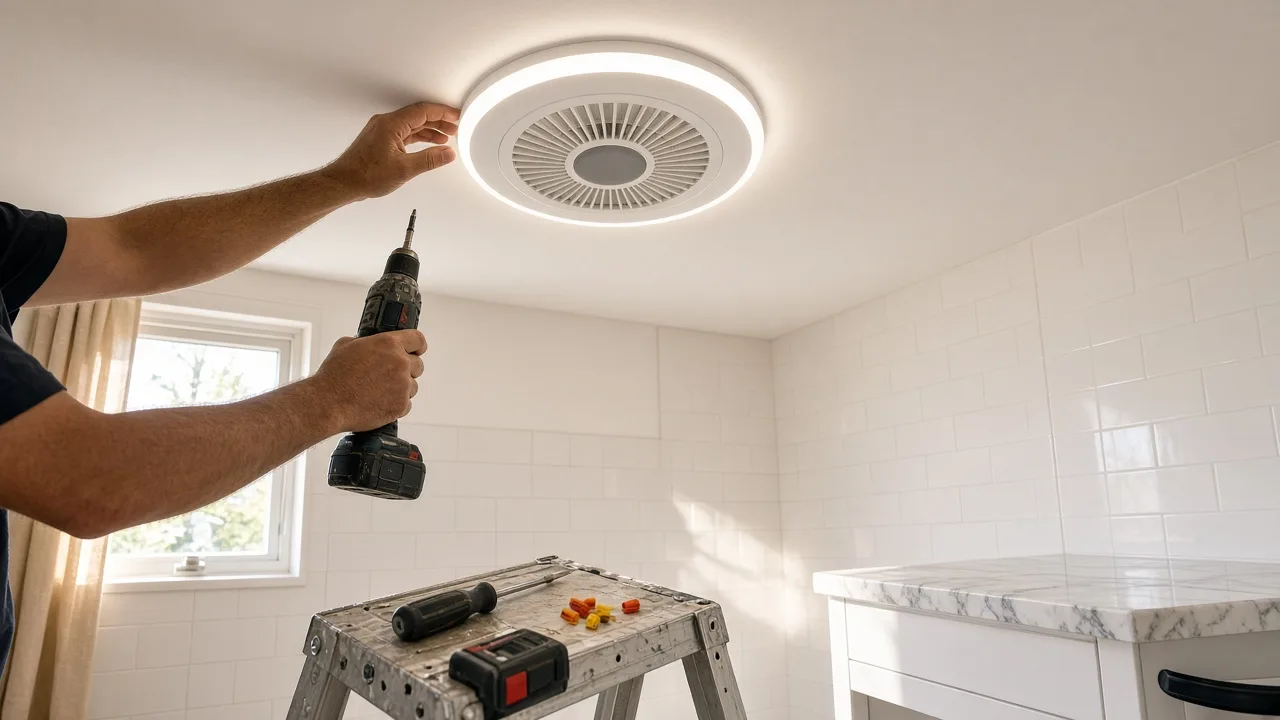
Replacing a bathroom fan is more than swapping one white box for another. In many San Antonio homes the fan is in the wrong place, the duct run is crushed or disconnected, or the wiring needs an upgrade, and each of those details decides whether the new fan is quiet and effective or loud and pointless a year later. Here is what a careful handyman installation actually covers.
- An attic check first: the ceiling opening, the joists and blocking, the available clearance, and the existing wiring before anything is cut
- A properly rated box and housing, mounted solid to the ceiling framing, not floating on the drywall
- Wiring connections made in the housing with the power confirmed off, on the correct bathroom circuit, and a switch or sensor installed where it is easy to reach
- A duct run with as few bends as possible, connected with metal tape or clamps at every joint, and insulated where it crosses the attic
- A new or renewed exterior cap, because a rusted flap or a crusted screen can close off the vent and trap the moisture you are trying to remove
- A test at the switch and at the wall cap outside, plus a check of the grille, the light kit, the sensor, and the final level fit
Signs your bathroom fan has stopped doing its job
Most homeowners never notice their fan getting weaker because it happens gradually, and by the time the mirror fogs for several minutes after a shower, the fan has usually been underperforming for months. These are the signs worth acting on.
- The bathroom stays steamed up for minutes after the shower with the fan on
- You can hear the motor but feel little air at the grille, which usually means a lint-clogged cover, a crushed duct, or a connection that came apart in the attic
- A mildew odor that lingers, or dark spots starting on the ceiling paint and grout lines
- The fan has gotten loud, a sign the motor is straining against a long or pinched duct run
- You can see insulation inside the vent tube from the attic side, or the exterior flap is stuck shut
- The unit is more than a decade old; modern Energy Star certified fans are quieter, use less power, and often pack a light and a humidity sensor in the same housing
Bathroom exhaust fan questions San Antonio homeowners ask
- Can you install a bathroom exhaust fan where there is not one now?
- Usually yes, and it is one of the most common jobs Ask for Chris does. The fan needs an electrical source nearby and a vent path to the outside, which can run through the roof, an exterior wall, or the soffit. We check the attic, confirm clearances, and give you an honest plan before cutting anything. In older San Antonio homes without a fan, this is the upgrade that stops the mildew cycle for good.
- How many CFM does my bathroom really need?
- The International Residential Code requires at least 50 CFM of intermittent exhaust or 20 CFM of continuous exhaust, and the Home Ventilating Institute recommends about 1 CFM per square foot for bathrooms up to roughly 100 square feet. A small powder room can use a 50 CFM fan, while a larger master bath is better served in the 80 to 110 CFM range. The shape of the room and the length of the duct run matter too, which is why a quick measurement beats a guess.
- Can the bathroom fan vent into the attic?
- No, and it is the most common installation mistake there is. Pumping humid air into the attic pushes moisture onto the underside of the roof deck and into the insulation, where it shows up as mold, rotted sheathing, and higher cooling bills in the San Antonio summer. Code requires the exhaust to go directly outside, and a proper install runs the duct to a roof cap, wall cap, or soffit vent with sealed connections.
- Why is my new bathroom fan so loud?
- Noise almost always comes from the duct, not the motor. A flexible duct pinched against a truss, too many elbows, or a duct that is too small adds resistance that makes the motor strain and the air whistle. Choosing a fan rated under about 1.0 sone, keeping the duct short and straight, and using rigid sections where the run needs to turn keep the bathroom quiet.
- Do I need an electrician to install a bathroom fan?
- When the wiring and the circuit are already in place, a bathroom exhaust fan installation is standard handyman work, and Ask for Chris does it with the power confirmed off and all connections made to code. When a new circuit, a new breaker, or a panel change is required, that part belongs to a licensed electrician, and a good handyman says so before the first screw.
Bathroom exhaust fan installation in San Antonio with Ask for Chris
From a quiet 50 CFM replacement in a Stone Oak powder room and a humidity-sensing unit in a Fair Oaks Ranch master bath to a brand-new fan, duct run, and wall cap in an older home in Alamo Heights, Boerne, or New Braunfels, Ask for Chris handles bathroom exhaust fan installation across San Antonio and the surrounding areas: Bulverde, Spring Branch, Canyon Lake, Helotes, Schertz, and the Texas Hill Country. Every job starts with an honest look at the room, the attic, and the vent path, and ends with a fan that clears the fog, dries the room, and keeps your bathroom fresh for the years of showers ahead. If you have been searching for handyman services San Antonio homeowners trust for home repairs and ventilation done right the first time, one call covers the list. Call (210) 951-9357 or email help@askforchris.com, available 24 hours a day.
Tip: run the fan for at least 15 to 20 minutes after the last shower, or install a humidity-sensing model and let it decide. Most bathroom mold problems in San Antonio are not fan problems, they are timing problems: the fan works, but nobody leaves it on long enough to clear the room. A timer or sensor switch turns a good fan into a working habit for a fraction of the cost of repainting the ceiling and regrouting the shower.