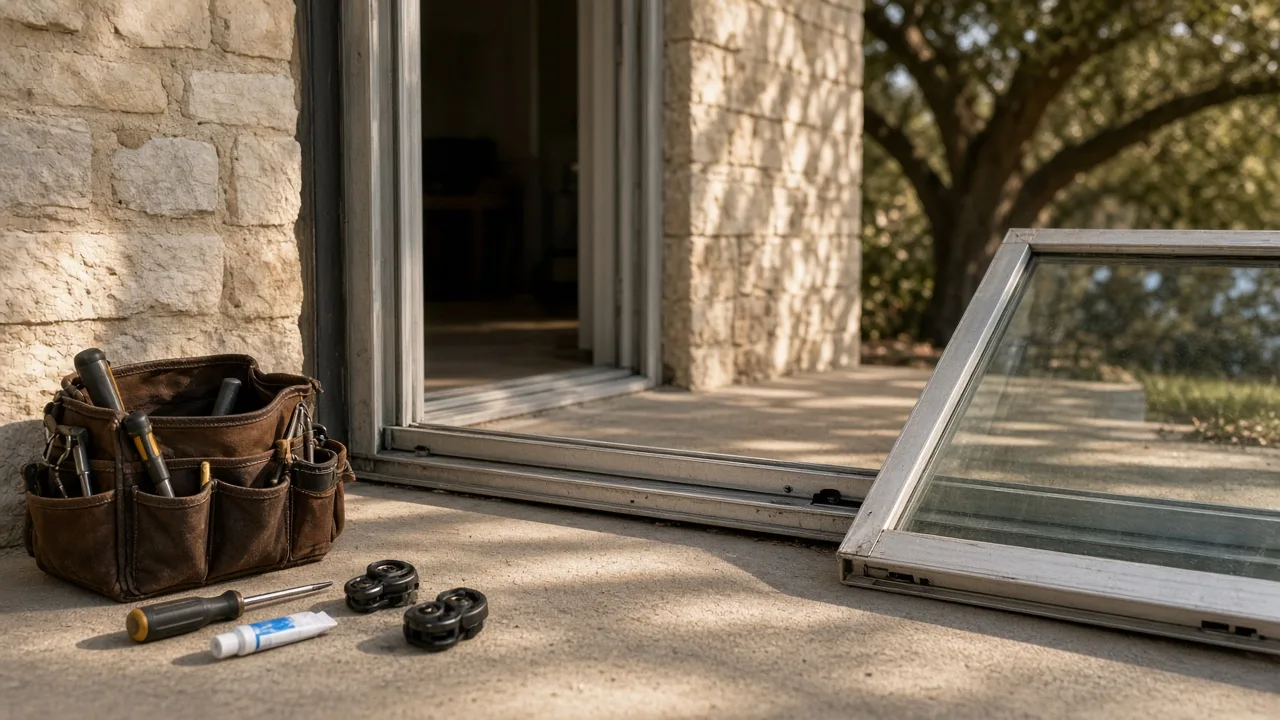
Why sliding glass doors stick, drag, and derail in San Antonio
Sliding glass doors fail in predictable ways, and almost all of them trace back to the track and the rollers. The bottom track on a Texas patio door lives outside: it collects dust, sand, leaves, and the fine limestone grit that blows across San Antonio neighborhoods every dry spell. That grit grinds the nylon wheels flat over the years, and once the rollers lose their shape, the door starts to drag on the track and the top edge tilts. On Hill Country homes, windblown dust and acorns from live oaks make the same job happen faster, and on limestone country, the dust mixes with a little moisture into a gritty paste that works like sandpaper on the track.
Heat matters too. The sun bakes the weatherstripping and the carrier seal along the edge of the door until the vinyl stiffens and cracks, and a dried-out seal is why a slider that used to shut tight now lets in noise, dust, and warm air in summer. Foundation settling finishes the picture: in the clay soils across San Antonio and the Hill Country, subtle shifts can rack the door frame just enough to make the lock stop lining up or the panels scrape. One thing homeowners do that makes it worse is forcing a stuck door: shoving a door that has jumped its rollers can bend the track and strip the wheel assemblies, turning a simple repair into a bigger one.
- The door drags or catches at the bottom and gets harder to open every month
- The top rail tilts away from the frame, a sign the bottom rollers are worn flat
- The door jumps the track, usually when gentle pressure on a dragging roller finally lets go
- A visible gap at the top or bottom lets in daylight, noise, and summer heat through the seal
- The lock or latch will not line up, often the first clue the frame has shifted a little
- The screen panel sags, tears, or will not roll, worn hangers or sun-brittle mesh
What professional sliding glass door repair includes
Most sliding glass door repairs are completed without touching the glass at all. The door panel comes off the track, the rollers are cleaned or replaced, and the track gets a thorough cleaning before anything goes back. When rollers are shot, new wheels matched to the door go in, the panel is re-hung, and the adjustment screws on the bottom edge are turned until the door rides level and glides with one finger. The weatherstripping along the jamb and the carrier seal on the door edge get replaced at the same time so the door shuts airtight again, and a misaligned lock or latch gets reset so it catches cleanly every time.
The honest part is knowing which jobs belong to a specialist. Broken panes of glass, sealed units that fog between the panes, and a full door replacement should go to a glass shop or a door company: the glass itself is heavy, expensive, and needs the right install so it does not crack under Texas heat, and a replacement door has to be sized and anchored to a frame that moves with the house. Ask for Chris gives straight advice on when a repair makes sense and when a replacement is the honest call, and the work never starts with a surprise quote.
- The panel is removed and the rollers are cleaned, adjusted, or replaced with new wheels matched to the door
- The track is cleaned top to bottom, because grit left behind will grind new rollers flat the same way it wore the old ones
- Weatherstripping and carrier seals are replaced so the door shuts tight against summer heat and Hill Country dust
- Lock, latch, and handle alignment are reset so the door catches cleanly every time
- The panel is re-hung, leveled with the adjustment screws, and tested until it glides smoothly
- Fogged glass, cracked panes, and full door replacements are referred to a glass or door specialist, honestly and up front
Sliding door screens: sagging mesh and tired hangers
The screen panel rides on its own set of hangers and rollers, and it takes the same abuse as the door in a smaller package. Screen mesh in San Antonio gets brittle in the sun and tears in storms, and the hanger wheels that ride the top track wear out just like the door rollers. A screen that falls off its track or drags across the threshold is usually fixed by replacing the hangers and re-tensioning the mesh, not by buying a whole new screen door.
San Antonio and Hill Country homeowners also use the slider screen as the main bug barrier for the patio, and there are mesh options that do more than keep bugs out. Pet-resistant mesh stands up to claws, and solar mesh cuts the afternoon sun and heat before it reaches the glass. Ask for Chris installs replacement screening in the existing frame when the frame is sound, and quotes a new screen door honestly when the frame itself is worn out.
- A screen that sags or drags usually needs new hanger wheels and re-tensioned mesh, not a whole new screen door
- Pet-resistant mesh holds up to dogs and cats that push through the screen when a guest comes to the door
- Solar mesh blocks a good share of the afternoon heat before it hits the glass, a real comfort win for west-facing patios
- Replace the mesh when it tears, not when it is merely faded: faded mesh still screens bugs and glare
Sliding glass door maintenance for San Antonio and Hill Country homes
A sliding glass door that is cleaned and lubricated twice a year will outlast one that is ignored. The single best habit is keeping the bottom track clear: sweep or vacuum grit out of the track every couple of weeks, because that abrasive is what actually wears the rollers out. Wiping the track edges after a wind storm keeps the fine Texas dust from building up into a paste, especially on Hill Country properties with gravel drives and live oaks.
For lubrication, the rule is silicone, never oil. A silicone spray on the rollers and the track keeps the door gliding without attracting the dust and grit that oil and grease grab like a magnet. Check the weatherstripping once a year and replace it when it stiffens, and watch the rollers: when the door starts to rub, adjust them with the small screws on the door's bottom edge, and the panels stay level for years. And never force a stuck slider: fix the cause first, because a hard shove is how tracks get bent.
- Sweep or vacuum the bottom track every couple of weeks, more often after wind storms and in oak and cedar country
- Lubricate rollers and track with silicone spray twice a year, and never use oil or grease, which grab dust
- Replace weatherstripping when it stiffens, usually every few years in direct Texas sun
- Adjust roller height with the screws on the door's bottom edge when the door starts to rub or catch
- Never force a stuck door: a hard shove bends tracks and strips roller assemblies, which turns a small fix into a big one
Sliding glass door questions San Antonio homeowners ask
- Can a handyman repair my sliding glass door, or do I need a glass company?
- Most everyday sliding door problems, rollers, tracks, weatherstripping, locks, and screens, are regular handyman work and are usually fixed in a single visit. A glass shop is the right call for cracked panes, fogged sealed units, and complete door replacements. An honest handyman tells you which one your door needs before work starts.
- Why does my sliding door keep jumping off the track?
- A door jumps the track when the bottom rollers are worn flat and the panel rides out of the groove, usually after years of grit grinding the wheels down and a little too much pressure on the door. Replacing the rollers and cleaning the track fixes it in most cases. If the frame itself has shifted out of square from foundation movement, the door may need realignment by someone who works on doors daily.
- How long does a sliding glass door roller replacement take?
- A straightforward roller replacement, with the track cleaned and the door re-hung and adjusted, runs about an hour. Doors where the frame has settled or the track is bent take longer, and you are told that before the quote instead of during the job.
- My sliding door lets in a draft: what is actually leaking?
- Usually the weatherstripping and the carrier seal along the door edge have stiffened and shrunk in the Texas sun. Replacing those seals is one of the fastest, cheapest fixes for a drafty slider, and it also cuts noise and summer heat gain. If the draft is at the bottom, the threshold seal may need replacing too.
- Should I replace the whole slider, or repair it?
- If the glass is good, the frame is sound, and the problem is rollers, seals, tracks, or hardware, repair is usually the right call and costs a fraction of a replacement. If the sealed glass unit has fogged, the frame is rusted or bent, or you want an efficiency upgrade in the glass itself, then a replacement is worth an honest quote from a door company.
Sliding Glass Door Repair in San Antonio with Ask for Chris
From a Stone Oak slider that jumps the track every spring to a Canyon Lake vacation home whose screen panel will not roll and a New Braunfels rental with a drafty patio door before guest season, Ask for Chris handles sliding glass door repair and the door work that comes with it across San Antonio and the surrounding areas: Bulverde, Boerne, Spring Branch, Helotes, Fair Oaks Ranch, Schertz, and the Texas Hill Country. Every job starts with an honest look at whether the fix is rollers, track, seals, locks, or screens, and it ends with a door that glides and a walkthrough of what was replaced. If you have been searching for handyman near me in San Antonio, or handyman services San Antonio homeowners rely on for home repairs done right the first time, one call covers the list. Call (210) 951-9357 or email help@askforchris.com, available 24 hours a day.
Tip: when the bottom rollers are replaced, have the track deep-cleaned at the same time. The grit that grinds rollers flat hides in the corners and under the door, and a clean track is what makes the new wheels last. Use a shop vacuum and a damp cloth before lubricating with silicone, never oil, and the door will glide like it did the first week.